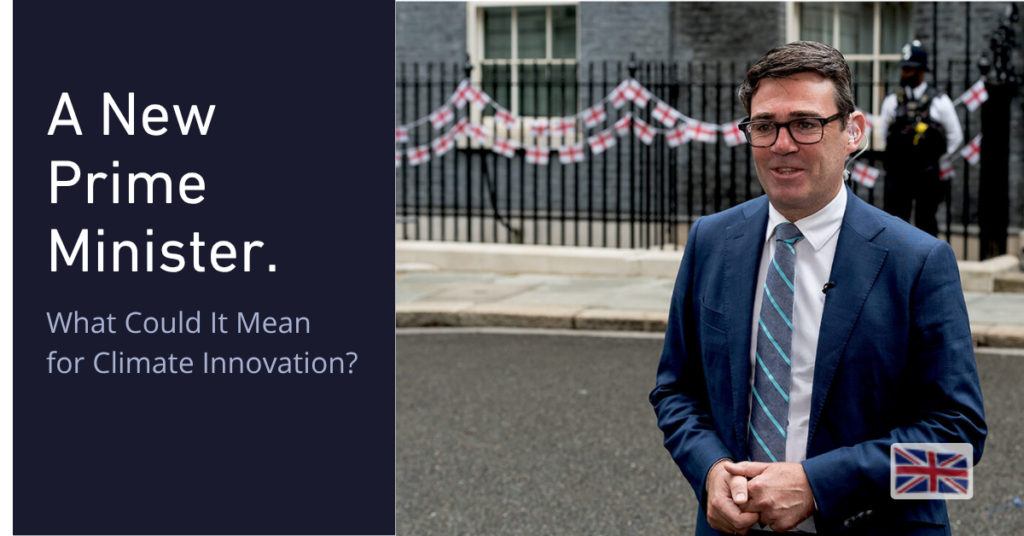
The appointment of another new Prime Minister inevitably prompts questions about the UK’s direction. With Andy Burnham taking office on 20 July, his early priorities have centred on boosting economic growth, investing in infrastructure, devolving power to regions and setting out a long-term plan for the country. While the political landscape has shifted, many of the UK’s biggest challenges remain unchanged.
Alongside this change in leadership, Ed Miliband’s move to become Foreign Secretary brings a new opportunity for Miatta Fahnbulleh, the newly appointed Secretary of State for Energy Security and Net Zero, to help shape a renewed consensus around how the UK balances the energy transition with economic growth, industrial competitiveness and national resilience. It has already been mooted that the new PM will support a return to drilling in specific North Sea projects. Whilst overall the move to reduce reliance on fossil fuels and to increase reliance on renewable energy is essential, there are some who have felt that the current cessation of drilling undermines both the short-term performance of the UK economy (and energy security) and the long-term propensity for UK companies to strive towards sustainable goals. It will be interesting to see the full details of Miatta Fahnbulleh’s policies and how she proposes to balance these potentially competing positions.
In reality, many of our economic priorities are closely linked to climate and resource resilience. Energy security, water infrastructure, industrial decarbonisation and resource efficiency are becoming central to discussions about productivity, competitiveness and long-term prosperity. If the government is serious about delivering sustainable economic growth, these sectors will need to play a leading role.
The investment case is already compelling, although difficult policy trade-offs are beginning to emerge. Burnham has already started weighing up competing priorities by announcing a reduced £2-per-journey bus fare cap in England. Increased public transport use (particularly where buses are using lower-carbon technologies) is one route to reducing emissions while helping to tackle cost-of-living pressures. However, the policy will be funded by diverting £454 million from international climate financing, illustrating the challenge of balancing domestic priorities with international climate commitments.
Despite these trade-offs, long-term investment trends continue to point in one direction. Global energy transition investment reached a record US$2.3 trillion in 2025, driven by growth in renewable energy, electrified transport and grid infrastructure, almost twice the amount expected to be invested in fossil fuels. In the UK, Ofwat has approved a record £104 billion for water infrastructure between 2025 and 2030, while the global wastewater treatment market is projected to grow from US$395 billion in 2026 to US$591 billion by 2030. The UK is also investing heavily in industrial decarbonisation, with £1 billion committed through the Net Zero Innovation Portfolio and a further £1 billion Carbon Capture and Storage Infrastructure Fund to accelerate low-carbon industrial clusters and unlock private investment.
These figures show where capital is increasingly flowing. Investors are backing businesses that solve real-world challenges with commercially viable solutions. Strong technology remains important, but so do experienced leadership teams, scalable business models and a clear path to profitability.
For founders, expectations have risen. Businesses are expected to demonstrate measurable impact alongside commercial resilience, proving they can grow sustainably in a more competitive investment market.
A change in political leadership won’t alter the long-term trends shaping the economy. The UK will still need cleaner energy, more resilient infrastructure and smarter ways to manage finite resources. What government can influence is the pace of progress by providing policy certainty, encouraging private investment and creating the confidence businesses need to invest and scale.
If the new administration can maintain that focus, the UK has an opportunity to strengthen its position as a global leader in climate innovation while supporting economic growth, regional development and industrial competitiveness.
Ultimately, success won’t be measured solely by environmental targets. It will be measured by our ability to build world-class businesses, attract investment and create an economy that is more resilient, more competitive and better prepared for the future.
Sources
- BBC News – Coverage of Andy Burnham becoming Prime Minister.
- Financial Times – Reporting on the Prime Minister’s economic agenda.
- Reuters – Analysis of infrastructure investment and regional growth.
- International Energy Agency – World Energy Investment 2025.
- Ofwat – PR24 Final Determinations.
- UK Government – Industrial Decarbonisation Strategy and Net Zero Innovation Portfolio.