Highlights from the Earth Capital Summit 2026, where founders, investors, advisors and business leaders met to talk about investment, innovation and impact, and about why capital has become more selective than ever.
THE DAY AT A GLANCE
| SESSION 1 · DATA
Fewer, bigger deals |
SESSION 2 · PANEL
Proof over potential |
SESSION 3 · PANEL
Pick the investor |
SESSION 4 · PITCHES
Three sectors, one vote Waste, water and grid innovation went head to head, and the room picked a winner. |
There’s no shortage of capital, but that capital is much more selective than it has ever been before.
~ EMMA BICKERSTAFFE · HOST, EARTH CAPITAL ADVISORY BOARD
That set the tone for the second Earth Capital Summit, opened by Alan Matthews, director of Earth Capital. Across four sessions, speakers looked at where climate tech money is going, what makes a business fundable in 2027, how to build the right mix of investors, and which sectors deserve attention now.
SESSION 1 · DATA SPOTLIGHT
Fundraising, M&A and where the action is happening
With John MacDonagh, PitchBook
PitchBook’s climate tech analyst opened with the latest data on where the money is going, and why the sector is being reframed.
In short: There is still money for climate tech, but it is going to fewer companies and to areas with a clear business case.
- Fewer, bigger deals. Climate tech VC funding rose to $47.9bn in 2025, up from $42.4bn in 2024, while the number of deals fell from 3,085 to 2,370.
- A new pitch for climate tech. The focus has moved from cutting carbon to resilience and energy independence. Demand from data centres is shaping much of the sector.
- Winners and losers. Nuclear, geothermal, grid infrastructure, energy storage and the built environment are growing. Hydrogen and carbon capture are struggling, while carbon removal is picking up again.
- Energy storage has flipped. From 2019 to 2023, about 75% of storage deal value went to lithium batteries. Since 2024, about 75% has gone to other technologies, such as flow batteries and long-duration storage.
- M&A is up in Europe. European climate tech M&A doubled to $6.0bn this year, from $2.9bn in 2025. John said a handful of large deals explain much of the jump.
- Investors are in it for the long haul. VCs held back during the political uncertainty of late 2024 and early 2025, but most still feel positive about the sector over the long term.
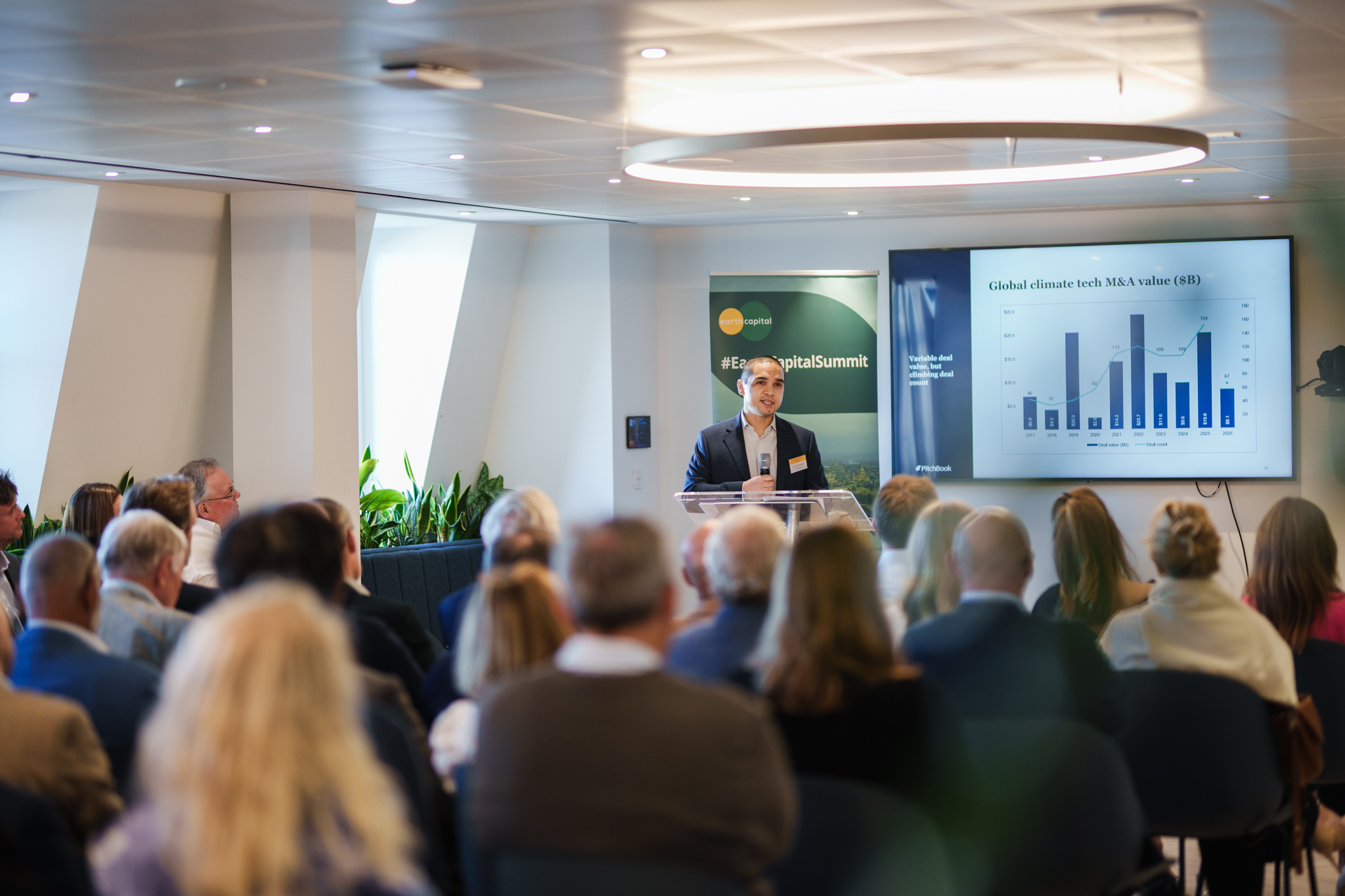
These are all areas that have a strong business case, even for people that essentially don’t care about decarbonisation at all. ~ JOHN MACDONAGH · PITCHBOOK
SESSION 2 · PANEL
From proof to profit: what makes a business fundable in 2027?
Moderated by Vanessa Neill Brown, Sustainability and Strategic Communications Consultant, with Dr Niki Hutson (Bureau Veritas), Carmel Rafaeli (The Table), Martin Brown (Elephants Child) and Lars Hagelmann (Big Issue Invest)
Investors are still writing cheques, but they want evidence. The panel looked at what separates an interesting idea from an investable business, and whether impact still counts.
In short: Investors back strong teams with real evidence, a clear funding plan and good governance. Impact matters, but only alongside a business customers will pay for.
- The team matters most. Every panellist put leadership ahead of technology, and using AI is now expected, rather than being a selling point. Lars Hagelmann said solo founders face bigger hurdles than a pair who can work off each other.
- Plan the funding for the whole journey. Carmel Rafaeli said founders should map out who will fund each stage. Hardware and infrastructure can take five to ten years to reach price parity, the point where they cost the same as what they replace.
- Purpose and profit go together. A strong impact story doesn’t replace a business customers will pay for. Lars added that founders and investors need to agree up front on the returns they expect.
- Be ready for change. Dr Niki Hutson said businesses should stress-test for policy changes, supply chain problems and climate risks, and be able to prove compliance and report clearly whatever the rules.
- Get governance in early. Martin Brown said good governance is where much of the value is created. Lars recalled reading one set of board minutes and putting in a turnaround finance director within 24 hours to stop a £10m loss.
- Traction before revenue. Pilots, letters of intent, offtake agreements (signed commitments to buy future output) and customer feedback on price all count.
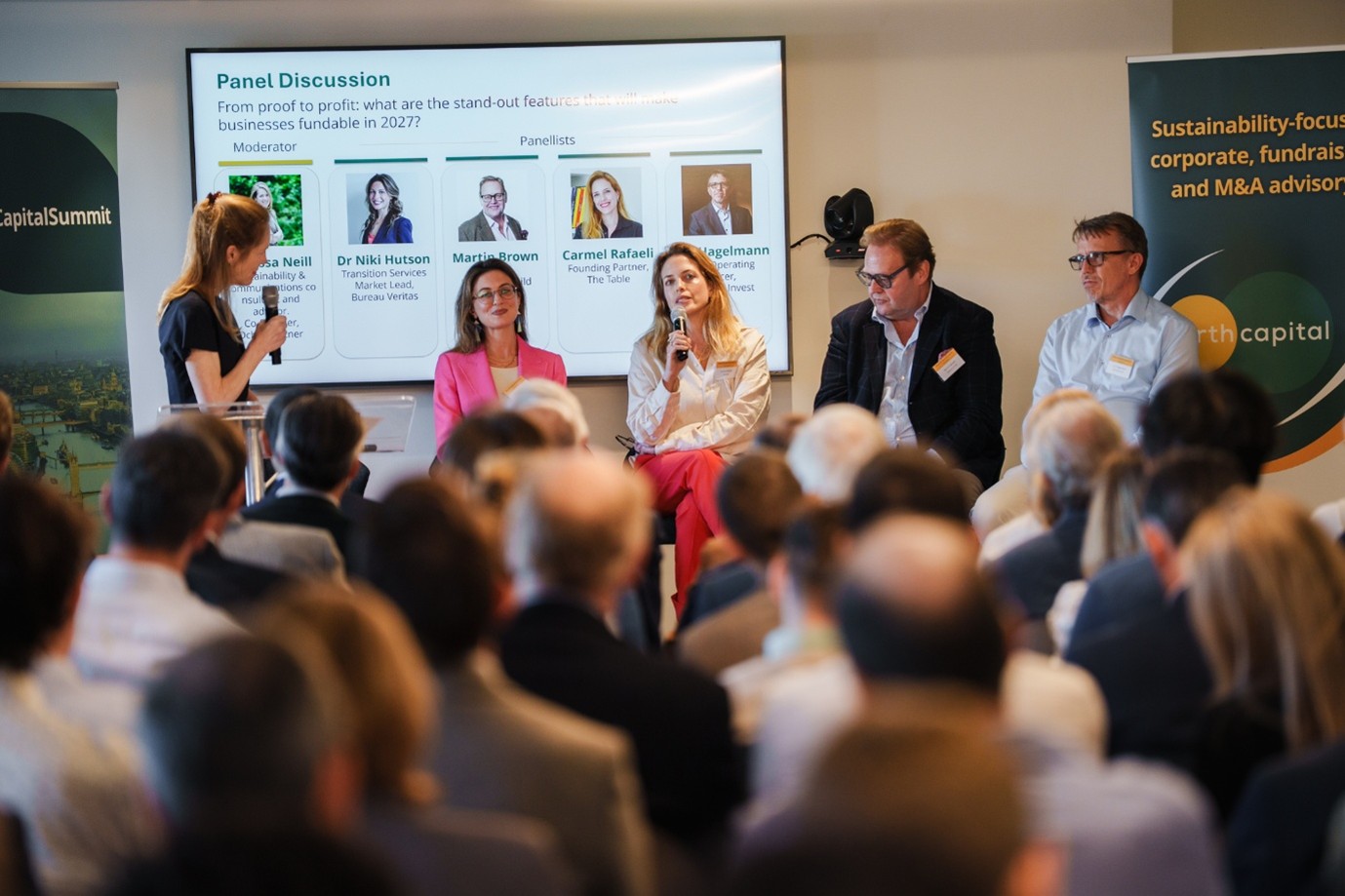
The narrative shift that we’ve seen in the last year is more about real evidence and proof rather than potential.
~ MARTIN BROWN · ELEPHANTS CHILD
Not every company needs to become a unicorn.
~ CARMEL RAFAELI · THE TABLE
SESSION 3 · PANEL
The private capital mix for scale
Moderated by Robert Timms, Earth Capital, with Rosie Marston (Harbottle & Lewis), Jorge De Rosa (James Fisher and Sons), Bernice Brooks (Guinness Ventures) and Rowan Bird (BGF)
VCs, family offices, corporate investors, lenders and private equity all play different roles as a company grows. The word that kept coming up was “balance”.
In short: There is no single right investor. The best mix changes as a company grows, so plan ahead and pick people you can work with for years.
- Match investors to your stage. Angels and EIS investors (who get UK tax relief for backing young companies) suit the early days. A lead investor, often a VC, should anchor bigger rounds. Later, growth funds focus on the numbers, such as growth rates and margins.
- Work backwards. Start with where you want the business to end up, then work out what each round needs to prove. Series A is often the step from proving the technology works to proving people will buy it.
- Corporate investors bring more than money. Jorge De Rosa of James Fisher said corporates offer access to customers and markets and a place to test technology. They move more slowly and take less technical risk, so they suit companies with a mature product that aren’t short of cash.
- Choose your shareholders carefully. A long tail of small angel investors who don’t understand how long deep tech takes can make later decisions hard. A strategic investor could also put off other buyers when it’s time to sell if they are seen as too restrictive.
- Debt comes later. Borrowing makes sense once revenue can repay it. Bernice Brooks said Guinness Ventures may block new debt if a company has no strong finance function. Convertible debt, a loan that can turn into shares, can bridge the gap between rounds.
- Build a proper board. Investors want independent voices, not just the founders and their friends. An independent chair or non-executive director helps, and investor consent rights should still work as the cap table (the list of who owns shares) changes.
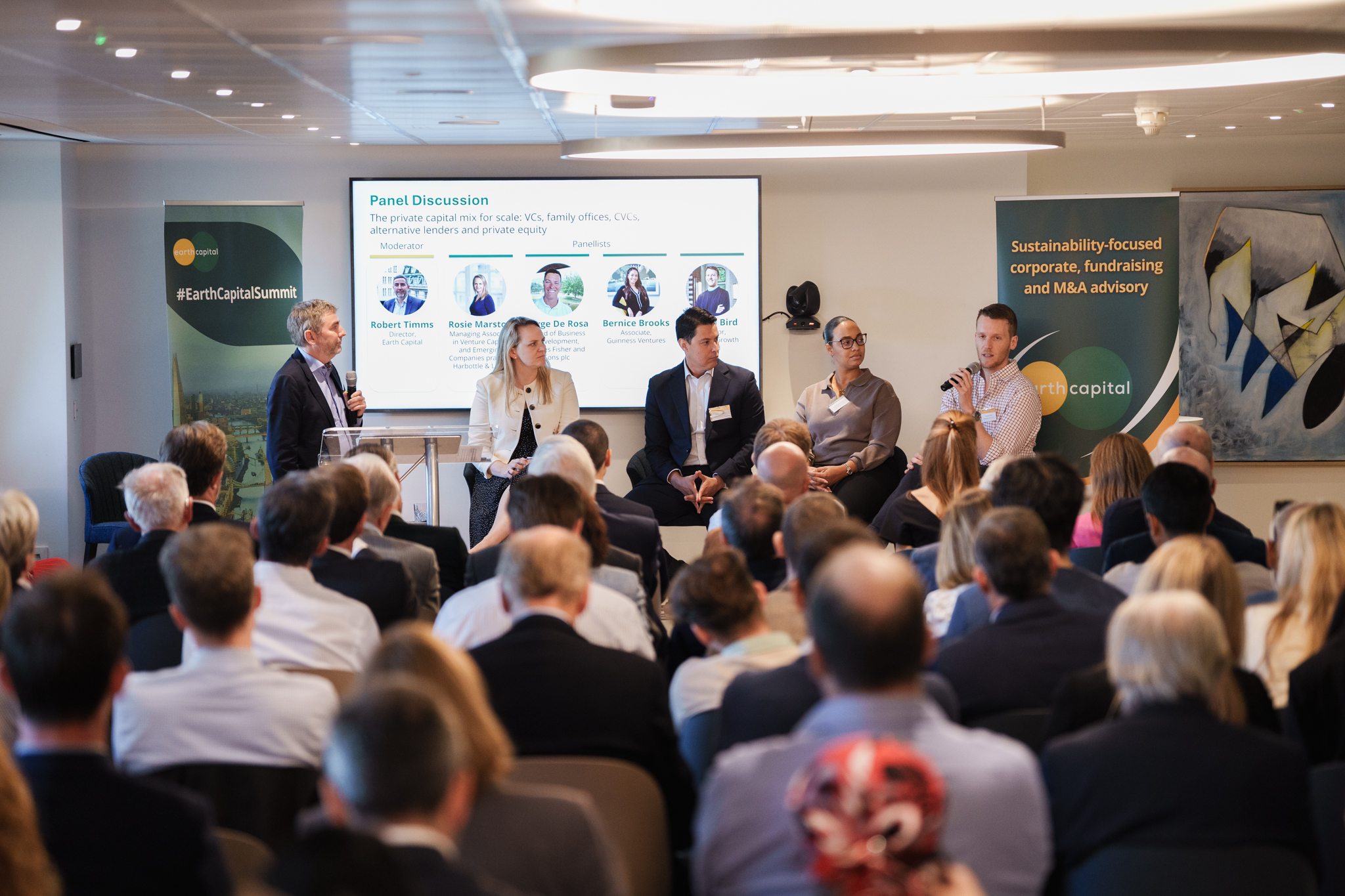
Choose the investor, not just the capital.
~ BERNICE BROOKS · GUINNESS VENTURES
You can always negotiate a term sheet, and seeing how the investor responds to the points you raise is really telling.
~ ROSIE MARSTON · HARBOTTLE & LEWIS
SESSION 4 · SECTOR SPOTLIGHTS
Waste, water and grid innovation: three pitches, one vote
In a Dragons’ Den-style finale, three experts each made the case for their sector. The audience then voted on which was most attractive for investment and scale.
Waste
Simone Aplin, Director, Ceres Waste, Renewables & Environment
The pitch: Waste is now a professional, regulated sector, and new policy is turning into real revenue.
- Policy is creating revenue. Packaging producers now pay to recycle what they sell, compulsory food waste collections are being rolled out across the UK, and energy from waste is due to join the UK Emissions Trading Scheme.
- Not enough capacity. The UK doesn’t have enough anaerobic digestion plants, which turn food waste into biogas, to handle all the food waste now being collected.
- Security of supply. Recycling cuts reliance on imported raw materials. The EU wants 25% of strategic raw materials to come from recycled sources by 2030.
- Something for every investor. Opportunities range from advanced sorting and biomethane to chemical recycling, carbon capture and sustainable aviation fuel. The risks include policy delays and swings in recycled material prices.
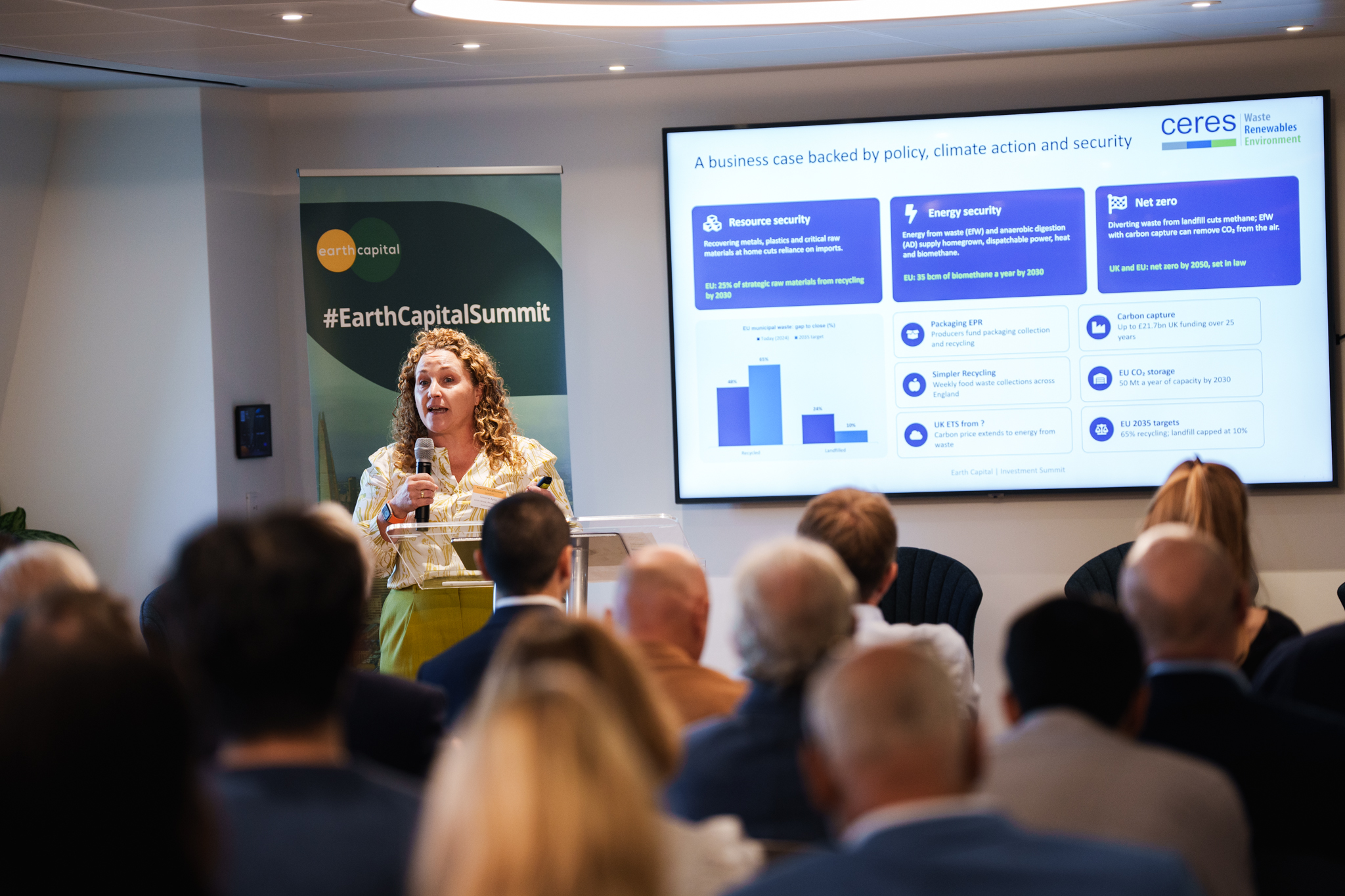
The sector is professional, it’s educated, it’s regulated, and it’s really focused on innovation and technology.
~ SIMONE APLIN
Water WINNING SECTOR
Andrew Raslan, Co-founder and CEO, Pipeline Organics
The pitch: Every business depends on water, and spending on resilience protects far more value than it costs.
- Resilience pays. Based on CDP research, every £1 spent on water resilience protects around £6 of business value.
- A shortage is coming. England could be short of 6 billion litres of water a day by 2055. That is the daily household use of around 43 million people.
- Every sector needs it. Food, drink, pharmaceuticals and AI data centres all rely on water. A less efficient brewery can produce up to seven litres of wastewater for every litre of beer.
- The rules are changing. The government plans to replace Ofwat with a stronger regulator, which opens the door to new technology for efficiency, reuse, treatment and recovery.
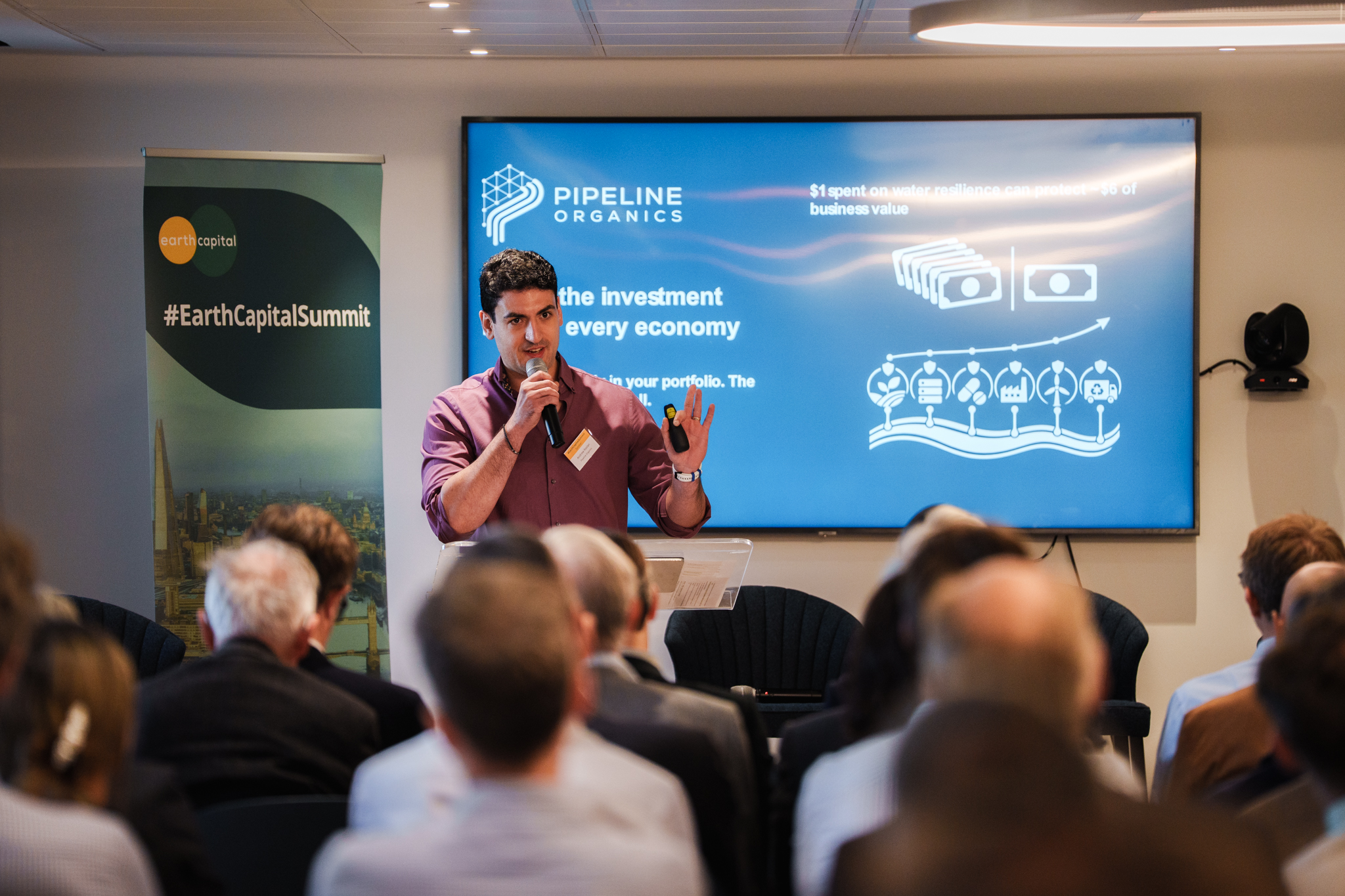
Every economy is a water economy.
~ ANDREW RASLAN
Grid innovation
Chris Paddey, Founder, Blue Ocean Boardrooms
The pitch: The UK can already make clean power. The hard part now is connecting, balancing and controlling it.
- A fast change. The UK grid has gone from 71% coal in 1989 to more than 50% renewables today, with millions of small, weather-dependent sources.
- The grid is the bottleneck. Long connection queues and network limits are holding back projects that would otherwise work.
- Three layers to invest in. Physical infrastructure (cables and substations), flexible assets (batteries, demand response, EV charging) and the intelligence layer (forecasting and control software).
- Use the grid you have. Chris described an industrial site stuck in a long, costly queue for a grid upgrade. A battery system cut its peak power costs, protected production and let it use more of its own renewable power.
- What investors look for. A real customer problem, a solution that can be repeated across sites, more than one income stream, and a team that understands both the energy market and the commercial side.
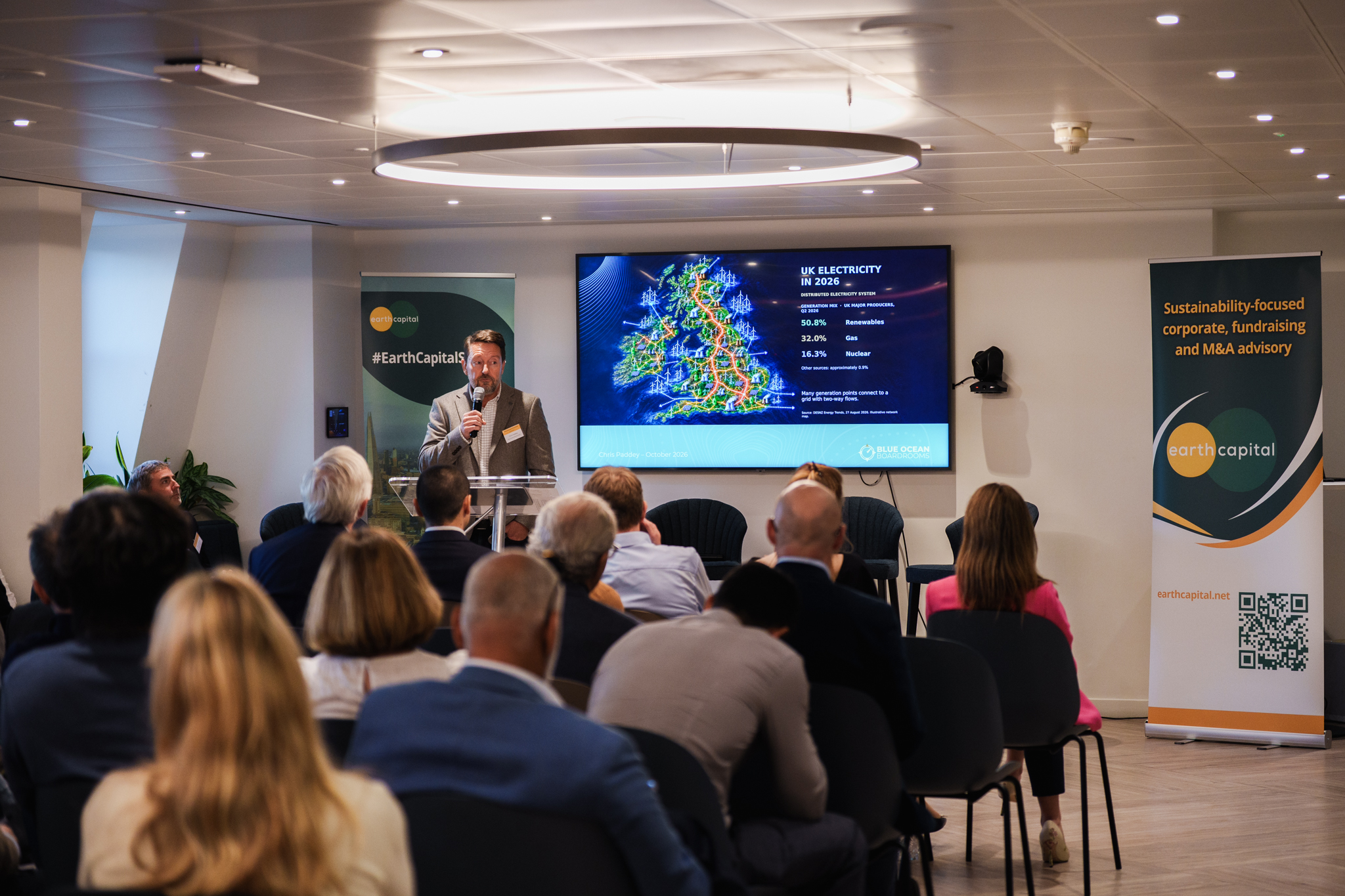
Look at it very much as being the operating system of an electrifying economy.
~ CHRIS PADDEY
| AUDIENCE VOTE · 49 VOTES CAST
And the winning sector was… Water Congratulations to Andrew Raslan of Pipeline Organics, whose case that every economy depends on water won over the room. |
WHAT ATTENDEES SAID
In their words
The Earth Capital Summit brings together a cross section of people (audience and speakers) interested in building great UK companies of the future. ~ Charles Breese, Larpent Newton
The summit was an engaging and informative event, in a great location. This is an agile and active sector, so hearing some of the latest views was thought provoking and helpful as we all try to make an impact, addressing the climate crisis.
~ Lee Billingham, Prime Advantage Capital PartnersI found the entire event interesting, informative and enjoyable. The speakers and forums were high quality. In addition it was an excellent networking opportunity. All in all a very good use of time getting updated on key sustainability issues.
~ Richard Angus, Hardman & Co.
KEY TAKEAWAYS
Five things for founders to remember
1 Show proof, not potential. Pilots, letters of intent and paying customers count for more than a good story.
2 Plan your funding for the whole journey, not just the next round.
3 Choose investors you can work with for years. Ask to speak to founders they have already backed.
4 Put governance and reporting in place early. It builds value as well as trust.
5 Build for the long term, not for the latest policy or trend.
ABOUT EARTH CAPITAL
Earth Capital is an impact-focused corporate advisory firm supporting ambitious businesses across their growth journey. We help companies with fundraising, M&A advisory, fractional CFO and value creation services, combining strategic advice with deep experience across climate tech, clean energy, water and resource efficiency and the wider impact sectors. Our aim is to help high-growth businesses scale their impact, strengthen their commercial foundations and access the right capital and strategic opportunities.
Download the Summit slides: Earth Capital Summit 2026 slides (PDF)
Talk to the team: Email us at reremita@earthcapital.net